Monday, April 20, 2009

A Taste of Italy: Gnocchi

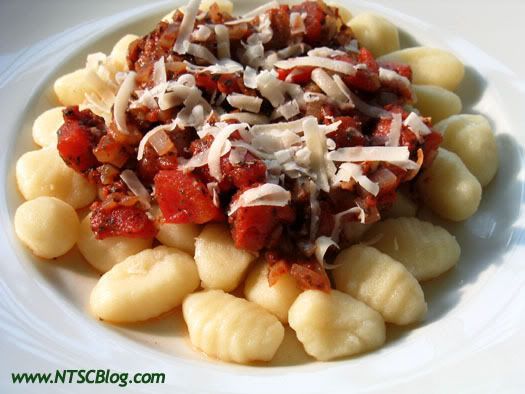
Until the mid 19th century, Italy was made up of city-states (separate kingdom) that occupied the peninsula and even today their government is made of many political parties. The first great ruler of Italy was Charlemagne who brought Frankish culture into Italy and gave power to the Church of Rome. Italy has become a very diverse culture with many cultures over the past who mixed their traditions with Italian customs. Jewish people came during the period of the Roman Republic, then Germanic tribes after the fall of Rome. Then during the 17th century, Austrians ruled Italy's biggest cities, Sicily, where many other cultures have already invaded. Today, each of Italy's regions are different, but linguistically the majority all speak Italian. Food customs, as it is in many countries, are the same, where any guest who visits will always be offered great hospitality and food. Food is a time to catch up with friends and family. Italian cuisine varies on each region, in the north, meals tend to be lighter and in the south, there is richer and heavier cooking. A favorite comfort food of many Italians is a dumpling called gnocchi that has been around since Roman times. Gnocchi can be made with potato flour, wheat flour, spinach, ricotta, or cheese. Gnocchi is pretty simple to make, but to save time, people can buy gnocchi at any local supermarket in the international foods aisle or frozen aisle. Here is a recipe to make a delicious tomato sauce gnocchi (if you don't want to make from scratch, buy frozen gnocchi in any Italian or local supermarket and boil in water):

Gnocchi (potato based)
Ingredients

3 pounds russet potatoes
2 cups all-purpose flour
1 egg, extra large
1 pinch salt

1/2 cup canola oil

Boil the whole potatoes until they are soft (about 45 minutes). While still warm, peel and pass through vegetable mill onto clean pasta board.

Set 6 quarts of water to boil in a large spaghetti pot. Set up ice bath with 6 cups ice and 6 cups water near boiling water.

Make well in center of potatoes and sprinkle all over with flour, using all the flour. Place egg and salt in center of well and using a fork, stir into flour and potatoes, just like making normal pasta. Once egg is mixed in, bring dough together, kneading gently until a ball is formed. Knead gently another 4 minutes until ball is dry to touch.

Roll baseball-sized ball of dough into 3/4-inch diameter dowels and cut dowels into 1-inch long pieces. Flick pieces off of fork or concave side of cheese grater until dowel is finished. Drop these pieces into boiling water and cook until they float (about 1 minute). Meanwhile, continue with remaining dough, forming dowels, cutting into 1-inch pieces and flicking off of fork. As gnocchi float to top of boiling water, remove them to ice bath. Continue until all have been cooled off. Let sit several minutes in bath and drain from ice and water. Toss with 1/2 cup canola oil and store covered in refrigerator up to 48 hours until ready to serve.

Tomato Sauce:
Ingredients


1/3 cup tomato sauce

2 tbsp olive oil
1 garlic clove


Add 1/3 cup of tomato sauce and simmer in a pan for about 5 minutes. For a delightful addition, add a few slices of porcini mushrooms. Crush the garlic and sprinkle on or add Parmesan cheese, then put into the oven for a few minutes to warm.
Enjoy with some fresh fruit juice or lemonade!

sources: http://www.everyculture.com/Ge-It/Italy.html http://www.world-food-and-wine.com/italian-gnocchi.html http://www.lifeinitaly.com/food/gnocchi.asp

Friday, April 17, 2009

A Taste of Russia: International Women's Day

One of Russia's most important holidays is International Woman's Day on March 8th. It celebrates the social, political, and economic achievements of woman. The holiday originally began in 1857 with a protest march by textile factory workers in the United States and spread to Russia after the October Revolution in 1917. It marked the achievements of women-workers in the USSR. In 1965, International Woman's Day became a national holiday, where women could take a break from work and maybe from chores, if her husband and children were feeling generous enough. Woman would also receive flowers and small presents from her family. Today, International Woman's Day has lost its feminist flavor and resembles a combination of Mother's Day and Valentine's Day. The day before, women bring home bagfuls of presents and flowers, returning late after the now popular corporate parties. The next morning, men crowd the streets, buying presents and flowers and make a big breakfast or lunch. Here is a recipe for a delicious and filling meal perfect for International Woman's Day:

Ingredients

2 lbs ground beef
2 medium onions, chopped
2 cloves garlic, minced
1 (4 ounce) can sliced mushrooms, drained
1 1/2 teaspoons salt
1/4 teaspoon pepper
1 cup beef bouillon or consomme
3 tablespoons tomato paste
2 tablespoons flour
3/4 cup sour cream, mixed with the flour

Brown ground beef in large skillet; add onions, garlic and mushrooms.
Saute until onion is golden brown.
Put in Crock Pot with all remaining ingredients except sour cream and flour.
Stir thoroughly.
Cover and cook on low 6-8 hours (or on High 3 hours).
Stir in sour cream and flour 1 hour before serving.
Serve over hot buttered noodles or rice.


sources: http://www.russianlife.com/article.cfm?Number=1621,
http://www.recipezaar.com/recipe/print?id=10146

Thursday, April 16, 2009

A Taste of Russia: Blini

Blini, similar to a French crepe, is a thin pancake from either white flour, buckwheat flour, cornmeal, but most Russians use wheat flour. In Russia, blini was eaten during pre-Christian times to honor the birth of the new sun, because of the round shape of the blini. Blini was also eaten to honor the dead. Today, blini is still eaten during the week of Maslenitsa (also known as Butter or Pancake Week) as the last week of dairy and egg products before Lent to follow with the Orthodox Church. Blini gets a lot of it's flavor from the different toppings. Some toppings can be sour cream, caviar, butter, honoey, fruit preserves, or smoked salmon. Here is a simple recipe to make a blini that is perfect for a small lunch or breakfast:

Ingredients

2/3 cup all-purpose flour
1/2 buckwheat flour
1/2 teaspoon salt
1 teaspoon instant yeast (not rapid-rise)
1/4 cup warm milk
2 tablespoons butter, melted
1 egg, separated
Toppings of choice

In a large bowl, mix flours, salt and instant yeast, and make a well in the center.

Pour in milk, mixing until smooth. Cover and let rise until doubled, about 1 hour.

Stir cooled melted butter and egg yolk into batter. In a separate bowl, whisk egg white until stiff but not dry. Fold into batter. Cover and let stand 20 minutes.

Heat a nonstick skillet over medium heat. Drop quarter-size dollops of dough into pan without crowding. Cook for about 1 minute or until bubbles form and break. Turn and cook for about 30 seconds. Cover blini and keep warm. Repeat with remaining batter.

Serve with toppings of choice: red or black caviar, smoked salmon or other fish, chopped hard-cooked eggs, minced red or white onion, sour cream or creme fresh, chopped dill and lemon wedges. Enjoy with some coffee, hot chocolate, or for those who are old enough some vodka.

sources: http://en.wikipedia.org/wiki/Russian_cuisine,
http://easteuropeanfood.about.com/od/noodlesdumplings/r/blini.htm

Wednesday, April 15, 2009

A Taste of Russia: Kvas

Kvas is the most popular drink in Russia, especially during the summer time. During the 19th century, peasants drank kvas very often, some say even more than water. Kvas is also known as "bread drink", but can also be added with fresh fruits and herbs during the spring time. It is usually made with rye, wheat, or malt flour that is boiled in water, then baked in an oven for 24 hours. Then the bread is dissolved in water for 2-3 hours and gets bottled. Kvas has a slightly alcoholic flavor, because of the way the bread is fermented, but the alcohol content is so small that children can drink it. Since the early 16th century, Russians have been drinking kvas for its unique sour taste and high vitamin B content. Today many street vendors sell kvas everywhere in Russia and if you can't buy it in Russia, you can have it shipped over to your home. If you want to try kvas, here is a website that sells it at a very cheap price:
http://www.russianfoods.com/showroom/product01422/vendor003E7/default.asp

Or you can try making it at home (good luck!):

Ingredients

1 lb stale black bread or 1 lb stale pumpernickel bread
1 cup sugar
2 tablespoons raisins
2 tablespoons fresh mint leaves or 1 tablespoon dried mint leaves
2 tablespoons Active dry yeast
1/4 cup luke warm water

Oven must be preheated to 200 degrees.

Cube the bread and then spread on a cookie sheet and place in oven for 1 hour.

Bring 6 quarts of water to a boil and drop in the bread.

Remove from heat, cover with a towel, and allow to sit at room temperature for 8 hours.

Strain through a fine sieve and press the juice from the bread.

Sprinkle the yeast and 1/4 teaspoon of sugar in the cup of lukewarm water and stir to dissolve the yeast completely.

Set aside in a warm place covered by a towel for approx. 10-12 minutes or until. mixture doubles in volume.

Add the mint leaves, and remaining sugar, stir well, then re-cover with the towel and set aside for 8-12 hours more at room temperature.

Again strain the mixture through a fine seive. Pour into a 1 gal. container, add the raisins, cover the top with plastic wrap, secure with a rubber band, and place in cool NOT cold, spot for 4-5 days or until the raisins are floating and the sediment has sunk to the bottom.

Pour off the clear amber liquid and rebottle in a clean jug or bottles. Refrigerate until ready to use.
You can enjoy kvas with a meat and vegetable dish or by itself.

sources:http://ask.metafilter.com/64513/Kvas-recipe,
http://www.traditional-russian-food.com/Kvas.html

Tuesday, April 14, 2009

A Taste of Russia: Pelmeni

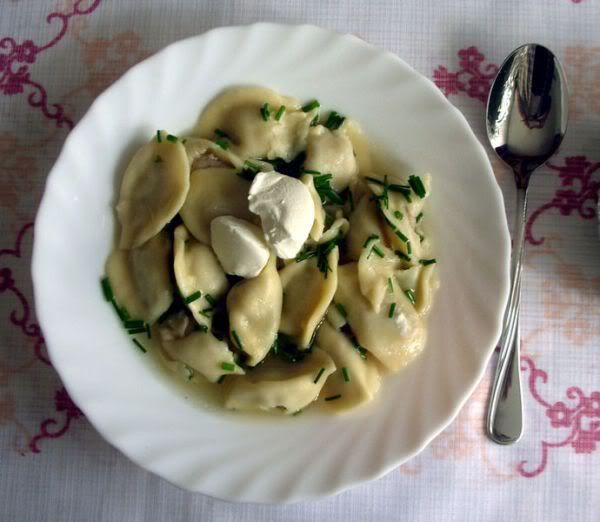
A Russian national dish and favorite is pelmeni. Pelmeni is a type of dumpling that can be filled with different meats like pork, chicken, and beef. To give it a spicy flavor, people add black pepper and onions. Pelmeni originally came from northwestern China, where the Mongols lived and spread to Siberia, then eventually reached eastern Europe during the 16th century. In the past, hunters made pelmeni to take with them on long-hunting trips for the winter. Pelmeni is a very non-perishable food and a light meal that can be eaten for lunch or a snack. Most Russian or Ukrainian supermarkets carry frozen pelmeni that can be boiled in chicken broth. Russians make pelmeni by boiling and sometimes frying then boiling, then they are topped with sour cream, melted butter, spicy mustard, or vinegar. Here is a recipe to make pelmeni, make sure you have a couple hours to make them:

Ingredients

1 cup all-purpose flour
1/4 teaspoon salt
1/3 cup water
1 egg
1/2 pound mixed ground beef, lamb and pork (by taste)
1 onion, chopped (about 1/4 cup)
1/8 teaspoon ground black pepper
1/4 teaspoon salt

Mix ground beef, lamb, pork, onion, 1/4 teaspoon salt and 1/8 teaspoon ground black pepper; reserve. Mix flour with egg (yolk and egg white) and water; 1/4 teaspoon salt until a soft dough forms. Knead on floured surface until dough is elastic. Divide into 1-inch round pieces. Roll each piece so that they are 1/16 inch thick. Fill each piece with the meat mixture; fold into half-moons. Pinch edges together and connect the opposite sides. Pelmeni can be frozen to be cooked later, or cooked immediately. To cook pelmeni, boil about 1/2 gallon of water; carefully drop pelmeni into boiling water. Boil for 20 minutes. You can different toppings like sour cream, melted butter, spicy mustard, vinegar, or soy sauce on pelmeni. If you have any leftovers, remember these dumplings will taste just as fresh when you freeze them. Enjoy these tasty dumplings!


sources: http://en.wikipedia.org/wiki/Pelmeni,
http://www.russiansabroad.com/cuisine/Recipe.asp?ComID=91

Monday, April 13, 2009

A Taste of Russia: Okroshka

Russia has had a difficult time building a culture with the tsarist and Soviet expansion. Many older generations only know of the Soviet cultural experience, because the Communist Party controlled and shaped daily life and social practices. Today many minority cultures are developing by reinventing their ethnic pasts. Russia is known for its philosophy, architecture, food, politics, etc. A very important symbol in Russian culture is Moscow's Saint Basil's cathedral with its colorful cupolas representing the country's long Orthrodox history. Many postcards, calenders, and posters are filled with images of the beautiful Saint Basil's cathedral. Many older cities like Moscow, Novgorod, Pskov, and Yaroslavl reflect Russia's complex and violent histories using architectural styles of Baroque, Renaissance, and Neoclassical. In the more urban cities are huge public parks where people spend time walking around, talking, playing chess, or reading. To unite the many ethnic groups, Russians speak in metaphors talking about soul dusha, which refers to the many ethnic groups uniting under a single multinational identity. Since the end of the Soviet repression, many holidays such as Christmas, Easter, and Russian Independence Day are celebrated. Russian cuisine hasn't changed, its foundations began long ago with different kinds of meats, fruits, vegetables, and rich stews and soups. For lunch, soups like okroshka are eaten with cabbage, potatoes, and ground meat cutlets. There are 3 types of soups: hot and cold. Okroshka is a cold soup that can be made with kvass (bread-based drink) or sour milk that is mixed with vegetables, meat, and fish. When making okroshka you put in a neutral tasting vegetable and a spicier vegetable such as a green onion to give it more flavor. Here is a variation recipe on okroshka that is a perfect for a warm summer day since there are no substitutes for kvass:

Ingredients:

1 cup meat, cooked
1 cucumber
2 eggs, hard boiled
3 onions, green
1 teaspoon sugar
1 teaspoon Dijon mustard
1/2 cup sour cream
4 cups apple cider

It is served with ice cubes in it. Dice meat. Peel and dice cucumber and eggs. Slice green onions. Combine first four (4) ingredients. Mix together sugar, mustard, sour cream, and cider, and beat well. Add beef mixture and chill. Serve sprinkled with dill. Enjoy!

sources:http://en.wikipedia.org/wiki/Russian_cuisine,
http://www.everyculture.com/No-Sa/Russia.html,
http://www.dailymunch.com/recipe-collection/soup/okroshka.html

Friday, April 10, 2009

A Taste of Canada: Fusion cuisine

Canada has been hit by a recession just like America and many people can't afford to eat in a high scale restaurants, but that doesn't mean people want to stop going out. So instead they find restaurants that are cheaper and taste just as good. Many Canadians are turning to Asian fusion restaurants with a casual atmosphere and that give great value for their money. Asian fusion restaurants combine different cultural foods like Japanese and Caribbean or Japanese and American. A more fancier and expensive fusion restaurant like the famous Gastropod is closing down to be replaced by a more simple and inexpensive Thai restaurant called Maenam. Despite the recession many Asian fusion restaurants are thriving, especially in Vancouver, Canada. Vancouver is known for being the melting pot of many cultural cuisines, especially Asian because of its close location to Asia. Owner of a hot dog stand, Noriki Tamura shows how Asian fusion food is growing by selling his Japadogs. Japadogs combine hotdogs and add an Asian twist with its delicious toppings. Another popular Asian fusion place is The Lion's Den Cafe that serves Japaribbean (Japanese and Caribbean) food. The laidback atmosphere, cheap prices, and exceptional quality of food in both the hot dog stand and The Lion's Den Cafe are what restaurants need to have in order to keep their customers during the recession.

source: http://thethunderbird.ca/2009/04/08/cheap-fusion-rides-out-the-recession/